
What Defines a High-Quality Paint Protection Film?
A Professional Guide from Material to Performance
In today’s automotive aftermarket, Paint Protection Film (PPF) has become a standard solution for premium vehicle protection. However, with significant variation in product quality, understanding what truly defines a high-quality PPF is essential for both professionals and end users.
Many vehicle owners have experienced issues such as stubborn water stains, surface marks, or adhesive residue left behind after film removal—sometimes resulting in high restoration costs. These problems are often directly related to material performance.
The Core Factor: TPU Material Determines Performance
Most suitable and correct material: Polycaprolactone TPU.
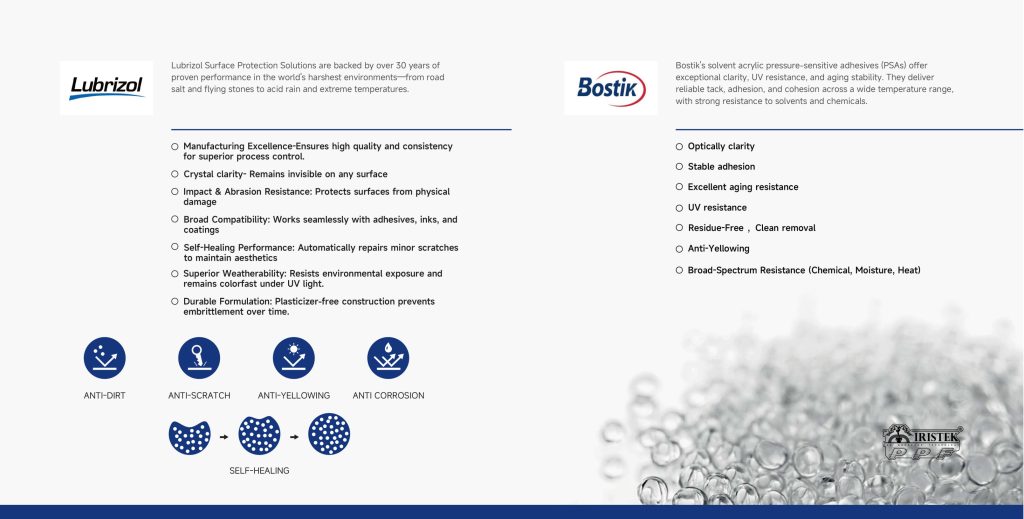
Polycaprolactone-based TPU offers superior molecular stability, providing excellent resistance to hydrolysis, UV exposure, and environmental stress.
In contrast, polyester-based TPU is more prone to hydrolysis due to its chemical structure, leading to degradation over time—manifesting as yellowing, brittleness, or adhesive failure.
Three Key Criteria to Evaluate PPF Quality
Even without deep technical knowledge, product quality can be assessed through three essential aspects:
1. Anti-yellowing Performance
High-quality PPF typically uses aliphatic TPU systems, maintaining clarity over time with only minimal aging effects. Lower-grade materials may show noticeable yellowing within a short period.
2. Durability & Lifespan
Industry benchmarks generally indicate:
Mid-range products: 3–5 years
end products: 8–10 years
Premium films remain flexible and safe to remove even after years of use, while low-quality films may become brittle and difficult to handle.
3. Material Stability
Stability under varying environmental conditions is a defining feature of premium PPF. High-quality films do not release residues or cause surface contamination.
Inferior products, however, may suffer from coating and adhesive instability, resulting in glue marks or irreversible damage to the paint surface.
Conclusion
So — what makes a good PPF?
It’s not how good it looks the day it’s installed.
It’s how gracefully it leaves years later.
Choosing PPF is like choosing a friend. Time tells the truth.